

The semiconductor equipment and services market is undergoing three major shifts. First, customers are demanding much higher uptime, faster response, and deeper technical ownership from service partners. Second, the market is moving from a purely capex-driven mindset to a total lifecycle mindset, where refurbishment, parts reliability, preventive maintenance, and tool life extension are becoming strategically important. Third, supply chain resilience has become a board-level issue. Customers no longer want only the cheapest source. They want trusted partners who can support continuity, quality, compliance, and speed across multiple regions.
At GTSS/GNS, we see this as a major opportunity. The winners in this market will not be simple traders. They will be companies that combine engineering capability, field execution, parts knowledge, and regional service infrastructure. That is exactly the platform we are building.
2. How are customer expectations evolving, particularly across different regions such as Europe and Asia?
Customer expectations are rising everywhere, but the emphasis differs by region. In Asia, speed, responsiveness, and operational flexibility are extremely important because fabs run in highly demanding production environments. In Europe, there is often stronger emphasis on documentation, compliance, traceability, and structured partnerships. Across both regions, however, the common expectation is very clear: customers want partners who are technically competent, dependable, and able to solve problems quickly without creating new risks.
What this means for GTSS/GNS is that we cannot take a one-size-fits-all approach. We must build a business that is globally disciplined but locally responsive. That is how you earn trust and become embedded in the customer’s long-term operating model.
3. What structural challenges do you see in the industry today, and how should companies position themselves to respond?
One structural challenge is the shortage of highly experienced technical talent, especially in specialized equipment support. Another is the increasing complexity of tools and the need to maintain performance and flexibility while managing cost pressure. A third is geopolitical and supply chain uncertainty, which has changed how customers think about sourcing, localisation, and risk diversification.
To respond, companies need to move beyond opportunistic growth. They need to invest in technical depth, standardization, collaborative innovation, customer intimacy, and regional capability. At GTSS/GNS, our view is simple: if you want to be relevant in the next phase of this industry, you must be trusted not only for what you sell, but for what you can sustain, restore, improve, and scale.
4. Your company has evolved from trading to a full-suite solution provider. What were the key strategic decisions that enabled this transition?
The key decision was to move up the value chain intentionally. Trading can open doors, but long-term leadership comes from technical capability and customer dependence on your execution, not just your inventory. We invested in engineering talent, field service capability, refurbishment know-how, process understanding, and regional support infrastructure. That allowed us to evolve from supplying items to solving mission-critical problems.
The second strategic decision was to stay close to the customer’s real pain points. Customers do not buy a part or a service in isolation. They buy uptime, reliability, faster recovery, and lower operational risk. Once we aligned our business around those outcomes, our role in the value chain became much more strategic.
This transition is important because it is also the foundation of a stronger, more scalable, and more defensible business model, which is essential for a company preparing for its next phase of growth.
5. How do you define your company’s role within the semiconductor value chain today?
We see GTSS/GNS as an enabling partner within the semiconductor value chain. We sit in the critical space between equipment capability and manufacturing continuity. Our role is to help customers maximize equipment performance, extend asset life, reduce downtime, and improve resilience through high-quality parts, refurbishment, engineering support, and field services.
In other words, we are not just supporting the ecosystem. We are helping make the ecosystem more efficient, more sustainable, and more dependable. That role becomes even more important as fabs look for partners who can combine technical expertise with execution speed and regional presence.
6. What differentiates a sustainable service and parts business from one that is purely transactional?
A transactional business focuses on the sale. A sustainable business focuses on the customer’s operating outcome. The difference is profound. A transactional business competes mainly on price and availability. A sustainable business competes on trust, repeatability, engineering value, responsiveness, and long-term customer relevance.
For me, a real service and parts leader must have three things: technical credibility, operating discipline, and customer intimacy. If you do not understand the tool, the application, and the customer’s production environment, you remain replaceable. But if
you become part of the customer’s reliability equation, you move from vendor to strategic partner. That is the kind of business we are building.
7. How should companies approach cross-border collaborations in today’s environment?
Cross-border collaboration today must be built on trust, complementary capability, and execution clarity. It is no longer enough to sign an agreement and hope synergies happen. The partnership has to create clear value for the customer, while also aligning on quality standards, technical responsibilities, compliance, and speed of execution.
At GTSS/GNS, we believe cross-border collaboration works best when each side brings real strength to the table. One may bring market access, another technical capability, or operational scale. But the common denominator must be professionalism and shared standards. In a more fragmented global environment, disciplined partnerships will matter even more.
8. You have managed operations across multiple territories. How do you approach market expansion while maintaining operational consistency?
My approach is to expand with discipline, not just ambition. Growth only creates value if it is repeatable and controllable. So when we enter or scale in a market, we focus on building the same core operating DNA: technical standards, internal control system, service quality, response discipline, customer engagement, and leadership accountability. The local market may differ, but the operating principles cannot be diluted.
I believe strong companies localise their execution without compromising their standards. That is how you scale responsibly. For GTSS/GNS, the goal is not just to be present in more markets. The goal is to deliver the same confidence to customers wherever we operate.
9. What factors do you prioritise when entering or scaling within a new market and how do regional differences influence your commerical and partnership strategies?
We prioritise four things: customer relevance, technical fit, talent availability, and execution economics. First, is there a real customer need that matches our strengths? Second, can we deliver differentiated value rather than just participate? Third, can we build or transfer the right technical and leadership capabilities? And fourth, can the market support a scalable and sustainable business model?
Regional differences absolutely matter. Some markets reward speed and flexibility. Others’ reward structure, qualification discipline, and longer relationship building. A strong company must understand both the economics and the psychology of the market. That is why expansion has to be strategic, not opportunistic.
10. The semiconductor industry is known for its cyclical nature. How do you plan for and manage these cycles?
I do not believe leadership in the semiconductor industry is about avoiding cycles. It is about building a business that can perform through them. We plan with the understanding that the market will move in waves. That means maintaining financial discipline, protecting cash, diversifying revenue streams, strengthening service-led business, and continuing to invest selectively in capabilities that will matter when the cycle turns.
One of the advantages of a strong parts and services platform is that it can create more resilience than a purely equipment-sales-driven model. Customers may defer certain capital decisions, but they still need uptime, parts, maintenance, refurbishment, and support. That is why I see resilience not as a defensive concept, but as a strategic design choice.
11. What are key risks you are currently monitoring, both operationally and at an industry level?
We monitor risks across three levels. At the operational level, we watch execution quality, technical manpower depth, supply continuity, and customer response performance very closely. At the industry level, we monitor demand cycles, customer capex sentiment, geopolitical developments, and the broader evolution of supply chain localisation. At the strategic level, we ask a bigger question: are we continuously building the capabilities that will keep us relevant three to five years from now?
For me, risk management is not just about avoiding downside. It is about ensuring the business remains trusted, agile, and prepared. That mindset is especially important for a company like ours as we position ourselves for the next stage of corporate growth.
12. How do you build resilience into your business model across different market conditions?
We build resilience by balancing ambition with discipline. That means having recurring and service-led revenue, staying close to customer operations, maintaining quality and response standards, and investing in talent and technical capability that customers cannot easily replace. It also means making sure our organisation is not dependent on one customer, one geography, or one type of opportunity.
In my view, resilience is not accidental. It is engineered. And in a market like semiconductors, the companies that engineer resilience well will be the ones that emerge stronger after every cycle.
13. Looking ahead, which areas of the semiconductor ecosystem do yo usee presenting the most significant change or opportunity, and how is your company preparing to respond to these shifts over the next 3-5 years?
I see major opportunities in lifecycle services, advanced refurbishment, localisation of technical support capabilities, and higher-value engineering support for installed tool bases. As fabs become more demanding on uptime and cost efficiency, the ecosystem around maintaining, upgrading, and optimising equipment will become even more important.
I also believe customers will increasingly value partners who can combine speed, engineering depth, and regional execution. The future will not belong only to those who make equipment. It will also belong to those who can sustain performance across the full operating life of that equipment. That is where GTSS/GNS is strongly positioned.
We are preparing in a very focused way. We are deepening our technical capabilities, strengthening our regional operating platform, investing in talent development, and building a more scalable service, equipment and parts model. We want GTSS/GNS to be known not only for reliability today, but for strategic relevance tomorrow.
Over the next three to five years, our ambition is to strengthen our position as a trusted semiconductor equipment, parts, and services leader in the region, while also building the governance, operational maturity, and growth quality expected of a publicly trusted company. That journey requires vision, but also discipline. We are committed to both.
14. What capabilities will be critical for companies to remain competitive in this space?
The critical capabilities will be technical depth, speed of execution, supply chain resilience, talent development, and the ability to build long-term customer trust. But beyond that, I believe leadership quality will be a major differentiator. In a more complex and more demanding industry environment, companies need leaders who can think strategically, act decisively, and build organisations that scale without losing discipline.
At GTSS/GNS, our focus is to build exactly that type of company: technically strong, commercially agile, operationally disciplined, and ready for the future.
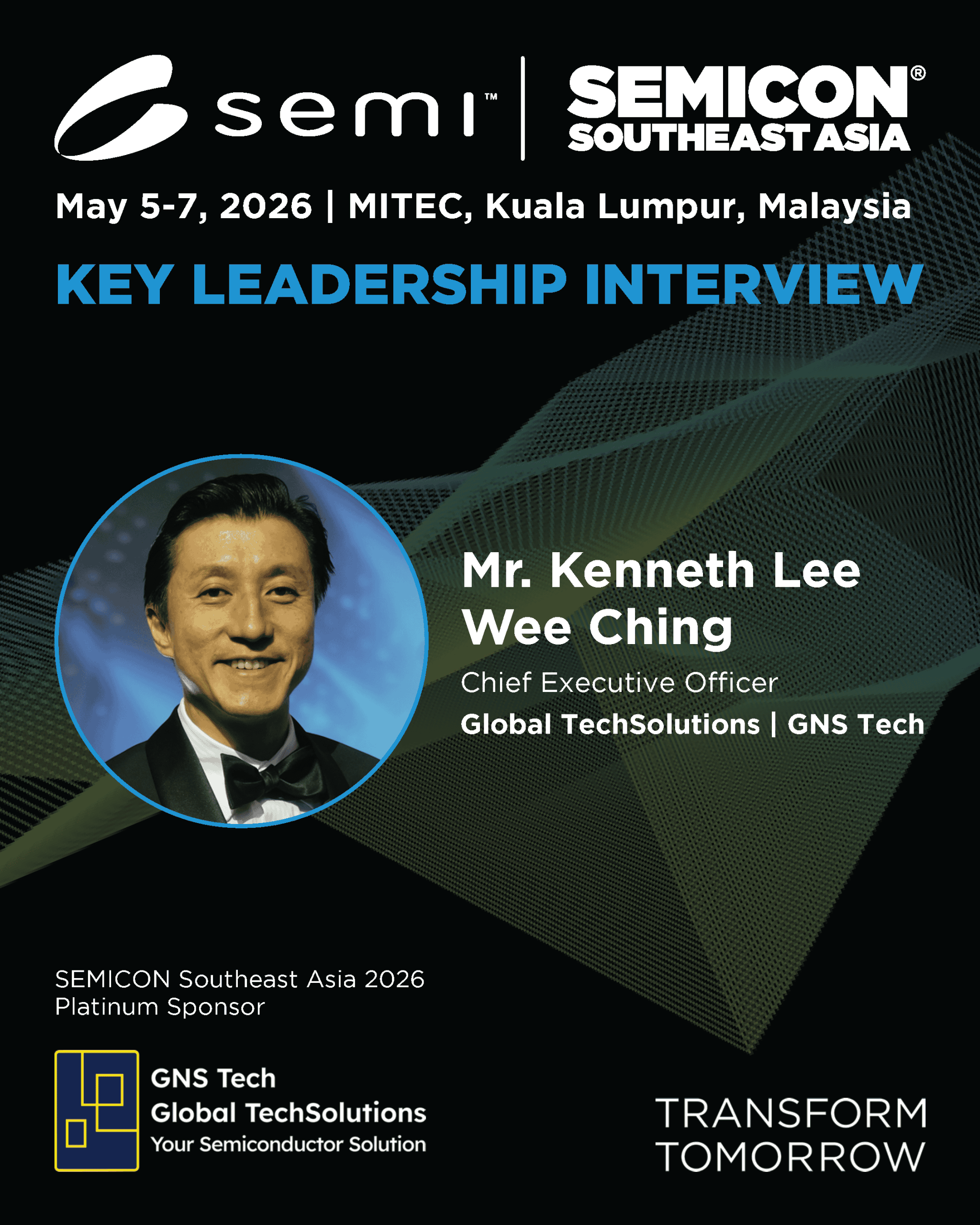
SEMI sat down with Kenneth Lee Wee Ching, our Chief Executive Officer, to unpack what’s changing in the semiconductor equipment and services landscape—and what it takes to stay relevant as fabs push for higher performance and stronger resilience.
In the interview, Kenneth shares three major shifts shaping the market today: rising expectations for uptime and response, a move toward a total lifecycle mindset (refurbishment, parts reliability, preventive maintenance, tool life extension), and supply chain resilience becoming a board-level priority.
He also reflects on GTSS/GNS’ evolution from trading to a full-suite solutions platform—built on engineering capability, field execution, and regional support infrastructure—and why disciplined expansion and operational consistency will define the next phase of growth.